General Dentistry
Patient Education in Santa Maria
Judgment-Free Care for Every Age
What Happens During a Patient Education Conversation
A patient education conversation is a two-way talk about your mouth. Your concerns come first. Then you learn what’s going on, why it matters, and what your choices are, so the decision you make is truly yours.
Think of it less like a lecture and more like sitting down with someone who knows teeth well and wants you to understand them too. At Brilla Dental Group, our dentists take time to hear your concerns first. Then they explain your oral health and walk through your treatment options so you can make an informed choice. That order matters. When you start with what’s bothering you, the rest of the talk stays focused on your real life and not on a checklist.
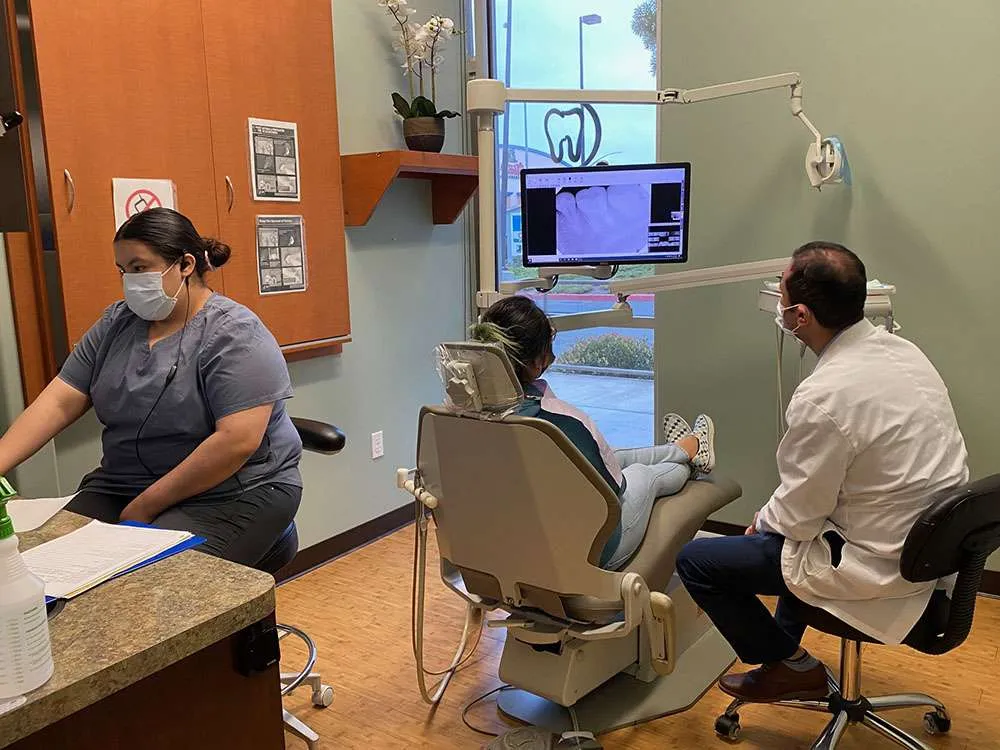
A good patient education conversation usually touches on a few key things:
- What you’ve noticed. This could be a sore spot, gums that bleed when you floss, a tooth that’s sensitive to cold, or simply a smile you’d like to feel better about.
- What’s happening. You get a plain-language explanation of the condition, such as early gum disease, a worn filling, or enamel that’s thinning.
- Why it matters. You learn how the issue could affect comfort, chewing, or the look of your smile if it’s left alone, and how quickly or slowly that tends to happen.
- Your options. These often include doing nothing for now, a simpler fix, and a more complete one. Each comes with its own trade-offs in time, comfort, and how long it lasts.
- What you can do at home. Small changes to brushing, flossing, or habits like grinding can make a real difference between visits.
Your part is simple: ask anything. There are no silly questions here. People often want to know if something will hurt, how long a treatment takes, or what happens if they wait. Others wonder if a cosmetic option will hold up to everyday chewing. If you’ve had digital x-rays taken, it’s fair to ask what they show and what the dentist is looking at. Hearing it in your own words, and repeating it back, is one of the best ways to make sure it sticks.
Here’s what a good conversation is not: a sales pitch. If an issue can safely be watched instead of treated right away, you should hear that. Sometimes the best plan is a better home routine and a closer look at your next checkup. Knowing that you can wait is just as useful as knowing when you shouldn’t.
The conversation also doesn’t end when you leave the chair. Our team closely monitors patients’ oral health over time, so the next talk builds on the last one. You can see whether that early gum irritation calmed down, whether a small spot stayed small, and whether your home care is paying off. Over time, you start to understand your own mouth, and that understanding is what helps a healthy, confident smile last.
Before your visit, it helps to jot down a few notes: any pain or changes you’ve noticed, medications you take, past dental work you’re unsure about, and one or two goals for your smile. That short list gives the conversation a clear starting point and makes sure nothing important gets missed.
WHAT TO ASK:
- What exactly did you see that led to this? Ask the dentist to point to it on your x-ray, a photo, or in your mouth. You'll feel better about a plan once you've seen the reason for it yourself.
- What are all my options, including the simplest one? A cracked tooth might be treated with bonding, a crown, or something else, depending on the damage. Ask what each choice does well and where it falls short.
- How long should this last, and what helps it last longer? Some repairs are built to hold up for many years, while others work better as a short-term fix. Your chewing habits, grinding, and home care all play a part.
- If I wait, what signs should I watch for? A clear answer turns waiting into a real plan. For example, you might hear that a spot is fine for now but needs a closer look if it starts to ache or catch food.
- Which part matters most if I can't do everything at once? Plans with several steps can often be ranked, with comfort and health first and cosmetic touches later.
- What will recovery feel like? Ask about soreness, eating, and time off work, so you can plan around your week.
Questions to Ask Before Agreeing to Any Recommended Treatment
Before you say yes to a filling, a crown, a deep cleaning, or a smile makeover, run through a few questions first. A good plan holds up when you ask about it. If the answers are clear and make sense for your life, you can move ahead feeling calm instead of pressured.
Cost deserves its own honest talk. In dentistry, the price of treatment depends on things like how many teeth are involved, the materials used, whether more than one visit is needed, and whether other steps come first, such as a cleaning before cosmetic work. Ask for a written breakdown of each step, and ask which parts your dental insurance may cover. Brilla Dental Group offers insurance and billing assistance, so it’s fair to ask for help sorting out your benefits before you commit.
Notice how your questions are received. You should get plain answers without feeling rushed or talked down to. It’s also fine to say you’d like to think it over, talk it through with your family, or get a second opinion. A plan that’s right for you will still be right next week, unless there’s an urgent problem like an infection. In that case the dentist should explain why it can’t wait.
When you understand the reason, the choices, and the trade-offs, you’re not just agreeing to treatment. You’re choosing a result that’s tailored to you and built to stand up to everyday life. That’s the kind of decision our dentists want you to make, and it’s why they take time to explain your options instead of handing you a list.
Common Treatment Decisions That Call for a Fuller Explanation
Some dental visits are simple. You get a cleaning, a quick check, and you’re on your way. Other visits end with a real choice to make, and that’s when a fuller explanation matters most. The decisions below have more than one good path. The right one depends on your health, your goals, and how you live, so you deserve to understand each path before you pick.
- A deep cleaning instead of a regular one. When you hear you need scaling and root planing, it can feel like a surprise, especially if nothing hurts. A regular cleaning works above the gumline. A deep cleaning reaches below it, where gum disease does its quiet damage. Ask the dentist to show you your gum pocket readings so the reason is clear. Our team uses laser techniques as part of periodontal therapy, and it’s worth asking whether that’s part of your plan.
- Saving a tooth or removing it. A badly infected tooth can often be saved with a root canal and a crown. Sometimes it can’t, and pulling it is the better choice. Saving your own tooth keeps your natural bite in place. Removing it may be faster, but then you’ll have a gap to think about. The strength of what’s left of the tooth usually decides it.
- How to replace a missing tooth. Dental implants, bridges, and complete or partial dentures each fill a gap in a different way. An implant stands on its own and often takes more time and steps, sometimes including bone grafting first. A bridge leans on the teeth next to it. Dentures can replace many teeth at once. Each one feels, cleans, and lasts differently, so this choice is worth a long talk.
- Which cosmetic option fits your smile. Whitening, bonding, and veneers can all brighten a smile, but they aren’t the same. Whitening changes color only. Bonding can reshape a chipped edge. Veneers cover the front of the tooth and may involve removing a thin layer of enamel, which can’t be undone. Knowing that ahead of time helps you choose a result that looks natural and holds up to everyday chewing.
- Braces or clear aligners. Both can straighten teeth. Traditional metal braces stay on all the time. Clear aligners come out to eat and brush, which means they only work if you wear them as directed. Your daily habits matter as much as your teeth here.
- Wisdom teeth that don’t hurt. It’s common to feel unsure about removing a tooth that isn’t bothering you. Ask what the x-rays show, such as how the tooth is angled and whether it’s pressing on nearby teeth. Some wisdom teeth can simply be watched over time.
What these choices share is that they’re hard to reverse. Once enamel is shaped, a tooth is removed, or an implant is placed, you can’t easily go back. That’s exactly why a rushed yes isn’t good enough. When you understand what each option gives you and what it asks of you, you can pick the one that fits your life, whether that means comfort first, lasting strength, or a smile that looks the way you’ve pictured it.
Many of these decisions also connect to each other. Healthy gums may need to come before veneers or an implant, for example. Our dentists watch your oral health over time, so a plan can unfold in steps that make sense together instead of feeling like a pile of separate fixes.
When You Don't Need a New Education Conversation
Not every visit needs a long sit-down talk. If you already understand your mouth and your plan, and nothing has changed, you can keep things simple. A good patient education talk is there when you need it. It shouldn’t take over your time when you don’t.
Here are some honest cases where you can usually skip a new, full conversation:
- Your checkup comes back the same as last time. If your gums look healthy, there’s nothing new on your x-rays, and your home care is working, a quick update is all you need. No news really is good news here.
- You’re coming in for a treatment you already chose. If you talked through a crown or a deep cleaning at an earlier visit and you felt clear about it, you don’t need to start from scratch on the day of treatment. A short check-in about what to expect that day is enough.
- You have one small question. Wondering if you’re flossing right or whether a toothpaste is okay for sensitive teeth? That’s a two-minute answer, not a full talk.
- You’re in pain and need relief now. If you have a bad toothache, a knocked-out tooth, or swelling, getting care comes first. The longer talk about long-term options can wait until you’re comfortable.
That last one matters. When you’re hurting, nobody wants a list of pros and cons. You want to feel better. A clear explanation of what’s being done right now, and why, is all that’s needed in that moment. The bigger choices, like how to replace a tooth or how to protect it for the future, are better made later with a calm mind.
It’s also fine to say “I’ve got it” if you already understand something. You don’t have to sit through an explanation you’ve heard before just to be polite. Your time is yours, and saying what you already know helps keep the visit focused.
On the other hand, some changes do call for a fresh talk, even if your last one felt complete:
- Something new shows up, like a sore spot, bleeding gums, a loose tooth, or a change in your bite.
- Your plan changes, such as a filling that now needs a crown, or a step that has to come before another.
- A lot of time has passed since you made your choice, and you’re no longer sure why you picked it.
- Your health or medications have changed, since that can affect your gums, healing, or which options make sense.
- Your goals have shifted. Maybe you were fine with a simple fix before, and now you’d like a smile that looks and lasts the way you’ve pictured it.
Because your oral health is followed from visit to visit, most of these changes get spotted naturally. Still, you know your own mouth and your own life best. If something feels different to you, or you just feel unsure, speak up. That’s the right time for a new conversation, and it’s never a bother to ask for one.
The simple rule is this: if nothing has changed and you feel clear, keep it short. If something has changed or you feel unsure, slow down and talk it through.
Explanations Adapted for Families, Children, and Anxious Patients
The same facts can land very differently depending on who’s hearing them. A seven-year-old, a parent juggling three kids’ checkups, and an adult who hasn’t seen a dentist in years all deserve the full picture. It just needs to be told in a way that fits them. Brilla Dental Group cares for patients of all ages, including families and children, so a good explanation here has to work for a small child and a worried grown-up alike.
For children, shorter is better. Kids follow along best with simple words, one idea at a time, and a chance to see what’s being talked about. A sealant can be described as a thin coating that helps keep food and germs out of the deep grooves in back teeth. Fluoride can be explained as a boost that helps make teeth stronger. When a child understands why brushing matters, they’re more likely to do it without a nightly battle. If your child has questions, let them ask first. It gives them some control, and that alone can make a visit feel less scary.
Parents often need a different kind of explanation, because you’re making choices for someone else. Decisions like whether a child needs a palatal expander, or when braces or clear aligners make sense, can feel heavy. It helps to ask:
- What happens if we wait a year and look again?
- How will this affect my child’s daily routine at school, at meals, and in sports?
- What will my child need to do at home, and what will I need to help with?
- Can we plan visits for more than one family member at the same time?
For anxious patients, the explanation itself can be part of the comfort. A lot of dental fear comes from not knowing what’s coming next. Hearing what each step will feel like before it starts, how long it lasts, and what you can do if you need a break can take much of the edge off. It’s fair to ask the dentist to talk you through things before they begin, to go slower, or to stop and explain again. You don’t need to apologize for being nervous. Many people feel the same way.
If fear has kept you away, it may help to know that Brilla Dental Group offers anxiety and phobia conscious care. You can ask about it when you call. A virtual dental consultation is another gentle first step. You can share your concerns and hear about your options from home before you ever sit in the chair.
Whoever you are, the goal stays the same. You should leave understanding your mouth and your choices well enough to feel calm about the next step. Your age, your nerves, and your family’s busy schedule just shape how that understanding gets built.
Frequently Asked Questions
Frequently Asked Questions
What does patient education do for me as a dental patient?
It helps you understand your mouth well enough to make your own treatment choices. Instead of just hearing instructions, you learn what a problem is, why it matters, and what your realistic options are. That understanding is what lets you choose confidently instead of just agreeing to whatever is suggested.
Are there different ways you explain treatment depending on the patient?
Yes, the explanation changes based on who is listening, not the facts themselves. A child gets short, simple ideas with a chance to look at what’s being discussed. A parent making decisions for a child gets practical questions answered, like how a treatment affects school or sports. An anxious adult gets a slower walkthrough of each step before it happens, so nothing feels like a surprise.
Can I bring a list of questions to my appointment instead of remembering them?
Yes, and it helps the conversation go better. Jotting down any pain or changes, medications you take, past dental work you’re unsure about, and your smile goals gives your visit a clear starting point. That short list makes sure nothing important gets missed once you’re in the chair.
Schedule Your Dental Appointment Today
Ready to get comprehensive care for your family? Visit Brilla Dental Group on North Broadway.
Visit Us
1846 N Broadway #B, Santa Maria, CA 93454
Languages
English | Español
Office Hours
Monday – Thursday: 7:30 AM – 4:30 PM
Friday: 7:30 AM – 4:00 PM
Saturday – Sunday: Closed